

I have spent the last decade exploring the world and spending long periods of time where I felt most at home—Greece, Portugal, South Africa, Australia and France, to name a few. What every place has in common is a shared reality, one which forms the fabric of their community. There is an implicit agreement that certain values and opinions are held amongst every member.
Society falls apart when trust erodes and the shared values become fragmented. We are social beings. Exclusion from the tribe used to mean certain death. Survival was reliant on a group of people each providing skills and resources for the betterment of the tribe. Hunters and gatherers. This system worked—until it didn’t.
It worked because of your proximity to the outcome. It had an immediate positive feedback loop. Your community knew whether you were useful and courageous. You couldn’t hide behind a screen. Modern life has inverted the incentives. Status is gained without competence. Attention is gained without substance. Opinions are given without wisdom or expertise. Ultimately, influence is awarded without accountability. When you create a society that values external appearances above substance and wisdom, bad actors rise to the top.
Watch the news or scroll on social media, you’ll be overwhelmed by narcissism, vanity and egomania. Loud voices, strong opinions, and very little substance. The US has a president with a Twitter addiction. Teenagers are watching Andrew Tate promote misogyny and the exploitation of women for financial gain. The AI overlords are building the machine that, by their own admission, may well end the human race, whilst they line their pockets and bask in their ever-growing social influence.
Whatever the arena, every one of these people has commonalities. When you strip it down to its bare bones, all great (meaning impactful) brands and personalities have three identifiable traits:
They have an ownable idea.
They have a common enemy.
They have an agenda.
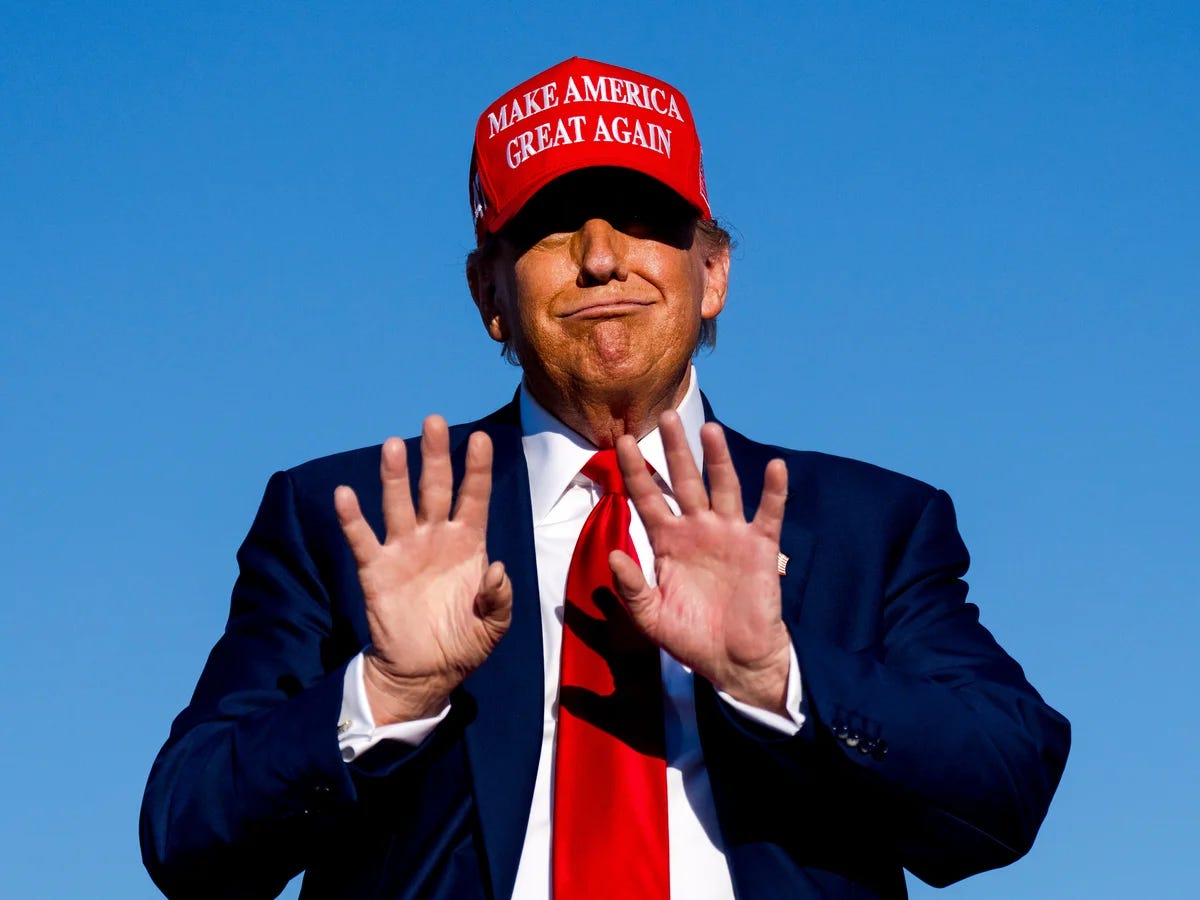
Trump owns Make America Great Again (MAGA). The enemy is the establishment taking their great nation away from the true Americans. The agenda is power, legacy and maintaining control.
Andrew Tate owns The Matrix. The enemy is ‘the system’ that keeps you complicit and broke. The agenda is social status, power, and financial reward. Watch any clip of Tate and within a few minutes he’ll mention how, at one point, he was the most Googled man on the planet. That is a statistic that, if true, only serves to elevate and highlight his status in society.
People like this have always existed. The difference is we removed the social filters. We gave everybody a voice and when you do that, you give everybody a voice.
Bad people, when viewed in isolation, are clearly bad. Small societies are great at uncovering bad actors because our survival depended on it. Tribes would cast out anybody who showed signs of misaligned values that could harm the group as a whole. Social isolation meant death in a world where we relied on one another. The internet allowed us to develop online tribes without the shackles of geography.
But tribes have a limit. This number is widely believed to be around 150 members, after which the social fabric falls apart. Social media created a globally connected planet and with a sample size of nine billion, you can find a few million people who support any ideology. We removed social filters and the gunk floated to the top.
When a group reaches millions of people, you become deindividualised. You no longer think as a single entity who faces consequences for your actions. You blend into the crowd and begin to operate with anonymity, which often leads to impulsive and antisocial behaviour. This psychological phenomenon is used to explain events such as the Holocaust, where seemingly normal people with no history of violence voluntarily took part in unspeakable acts.
The same happens with social media.
When you see a fascist or racist tweet, most of us have the cognitive reasoning to understand that it’s inherently bad. When you see the same tweet with thousands of likes and retweets and the message being supported by others, you begin to let the idea sit with you a little longer. We are social creatures who deviate towards the general consensus. By nature, we don’t want to stand out. Slowly but surely, your opinions change and you become desensitised to the message, sometimes even becoming a supporter. You diffuse responsibility from yourself to the group.
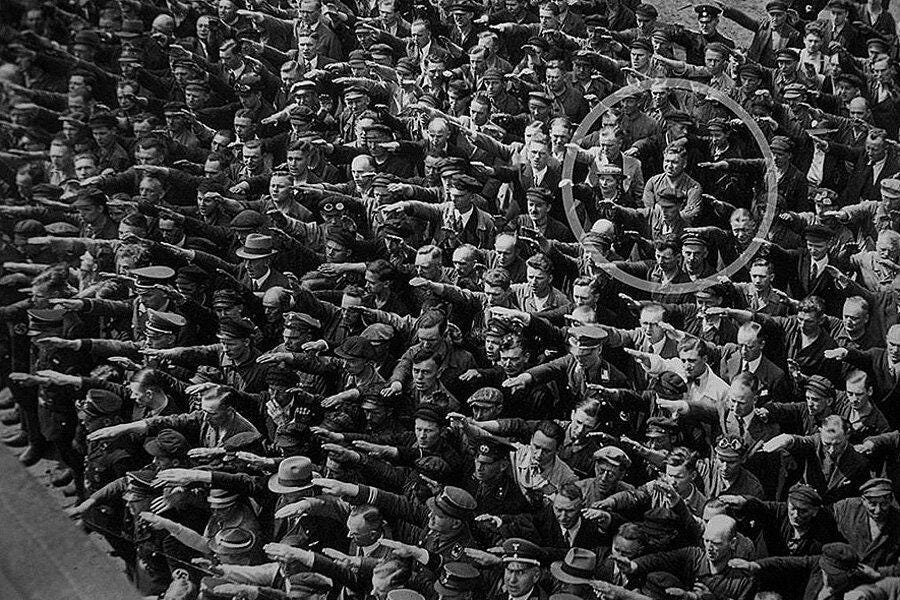
Worse still, you begin to believe opinions held by the few are reflective of the masses. In reality, social media is dominated by superposters who skew reality. Most of us are onlookers—we scroll and consume instead of creating. Every social media platform is dominated by a very small percentage of superposters who, as a result of volume, end up writing the narrative.
Much of what I’m about to share is extracted from The Chaos Machine by Max Fisher, which I highly recommend reading.
Superposters have very distinct personality traits which means they find gratification in heavy social media use. These traits are broadly negative.
The first is dogmatism, defined as the tendency to hold beliefs rigidly and with excessive certainty, even in the face of criticism. This is very common with conspiracy theorists. If you disagree, you’re wrong, brainwashed by ‘the system’ and part of the problem, regardless of how sound your counterargument is.
Another trait is grandiose narcissism. This is an inflated sense of self-importance, entitlement and a need for admiration. These people view themselves as destined for exceptional things and deserving of recognition. Social media is a breeding ground for grandiose narcissists thanks to its immediate feedback loop, unlimited audience and measurable status benchmarks (followers, likes, comments). The language in itself suits their personality: they don’t seek connections or friends, they seek followers.
Psychologists and neuroscientists found that social media is not to blame for the behavioural traits of superposters. They were already like this. Individuals who promote hostility online are predisposed to be hostile in all contexts. Simply, their hostility is not a result of using social media but they use social media as a means to spread their hostility effectively.
This is an extract from The Chaos Machine by Max Fisher:
“superposters are drawn toward and feel rewarded by negative social potency, a clinical term for deriving pleasure from deliberately inciting emotional distress on others…
…We like to think of ourselves as following an innate moral code, derived from soft principles, lived experience, the advice of a trusted elder. In truth, studies find over and over, our sense of right and wrong is heavily, if unconsciously, influenced by what we believe our peers think: morality by tribal consequences, guided not by some better angel or higher power but by self-preserving deference to the tyranny of cousins”
When these superposters are removed, social media becomes a different environment. Ellen Pao was the CEO of Reddit. In 2015, there were about 36 million registered Reddit accounts. Her team concluded that of the millions of users, only around 15,000 accounts were hyperactive with regard to promoting hateful content. They removed this very small subset of users and hate speech dropped 80%. When broken down as a percentage, around 0.04% of Reddit’s user base was responsible for 80% of hate speech.
So, where have all the good people gone?
Well, nowhere. They just don’t hang out where you’re looking for them. Good people are simply less predisposed to excel and flourish in the online world we created and they’re less interested in playing the status game.
We built a machine that favours the innate personality traits of bad actors. It’s like asking the question where did all the short basketball players go? They didn’t go anywhere, we just created a game that they can’t play.
This is entirely our own doing. We may not have built the machine but we vote with our thumbs every time we scroll. The algorithm is built on learned behaviour and we taught it.
If you are still yet to be convinced, ask yourself: what do the creators of these great technologies allow in their homes?
Tobacco execs do not allow their children to smoke.
Steve Jobs would not allow his children to use an iPad.
Zuckerberg limits technology use in the home, emphasising the importance of deliberate consumption and play.
Yes, the very tycoons selling you their breakthrough technologies do not allow the same technologies to plague their families and their homes. If it’s still not clear—you are the product.
If you want status online, be loud, uncompromising, polarising, disagreeable and narcissistic. If you want to be a good person, stay offline.
Go outside,
Robbie
“The narcissist enjoys being looked at and not looking back.”
Mason Cooley