

Embarrassment holds the social fabric of society together.
It’s a forcing function for learned behaviour. It’s an unpleasant emotion which is why it’s useful. Tripping over in front of a group of people is embarrassing, but only for about twenty seconds then nobody cares. But embarrassment as a result of behaviour is a social feedback loop that functioning societies rely upon to maintain order.
If you do something that makes you feel embarrassed, you have violated a social norm. Your behaviour was incongruent to what the society or your peer group deems acceptable. The feeling of embarrassment is what makes you want to correct the behaviour. It’s self-regulating—you don’t need to be formally punished as the feeling is punishment enough. This is how group norms remain intact and societies thrive.
Embarrassment also strengthens relations within a group. It makes us human and fallible, which makes us more likeable and relatable to our peers. Think about any of your close friends and you’ll have multiple embarrassing stories about each one of them. Those embarrassing moments didn’t happen because you are friends. Those moments are part of the reason you are still friends.
Technology altered the fabric of society.
Prior to social media, embarrassment was localised, temporary and proportionate to the action. It would be experienced by a very select number of people and after a period of time, depending on what you did, it would be forgotten. Thanks to social media, embarrassment can now be broadcast to the world. It is global and disproportionate. When embarrassment is viewed without context and outside of the social group, it quickly becomes humiliation.
We have countless examples of this happening in the past decade.
Justine Sacco, a PR executive, was flying from New York to Cape Town when she took to twitter to share her inner thoughts with her 174 followers: “Going to Africa. Hope I don’t get AIDS. Just kidding. I’m white!”
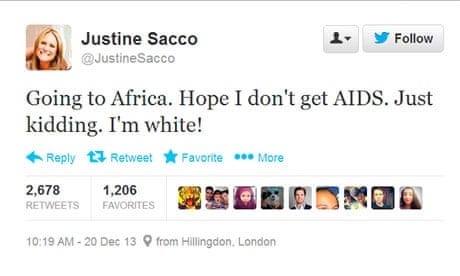
When she landed, #HasJustineLandedYet was trending and the social media mob had rallied against her. She was fired from her job. Justine, who is South African herself, later commented that her tweets were intended to mimic the ignorance of Americans and “mock what an actual racist, ignorant person would say.” Sam Biddle, the blogger who promoted the hashtag, later apologised and admitted he did it to drive traffic to his own internet blog. Biddle went on to say “it’s easy and thrilling to hate a stranger online”—that’s the real problem with social media’s mob mentality.
What’s more worrying is that given the discourse of Twitter (X) today, this tweet would unlikely make a ripple in the cesspool of fascist and racist content being produced.
What social media does allow for is a public trial where, as is often the case, the person pointing the finger becomes the focus of the mob. One such case is Donglegate, where Adria Richards overheard two men behind her at a programmer conference making innaproporate sexual jokes about “dongles”.
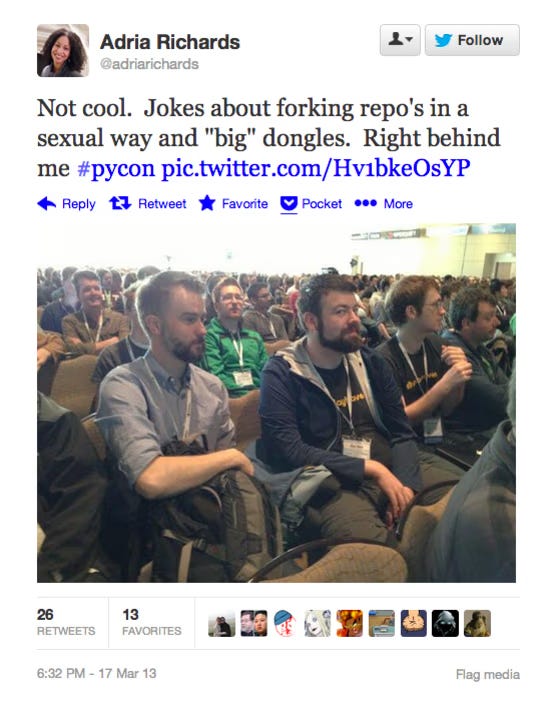
Richards tweeted a photo of the men including the statement: “Not cool. Jokes about forking and repo’s in a sexual way and “big” dongles. Right behind me”. One of the men photographed had his employment terminated the following day. The internet responded by turning against Richards, launching a cyberattack against her company, SendGrid. Richards’ employment was also terminated.
Jon Ronson covers both examples in much greater detail in his book, So You’ve Been Publicly Shamed, which I recommend reading.
What’s common in both these examples is that social media removes the filter of distribution. In the real world, these embarrassing and distasteful comments are localised. Social media allows the mob to grow, with each new voice being further detached from both the context and the outcome. This is worsened by the anonymity of social media and lack of accountability.
Take these two examples:
Example A:
You tell a rude joke that the group doesn’t find funny. Your friend tells you it’s innapropriate and the group agrees. You feel embarrassed for a short while and then everybody moves on. You’ve learned.
Example B:
You tell a rude joke that the group doesn’t find funny. Your friend berates you in front of everybody, screaming at you and calling you names. Your friend gets chastised by the group for being too harsh on you and taking it too far. They are embarrassed. You have both learned.
These examples work in the real world because social norms dictate what is appropriate. The group is self-governing. Now imagine another scenario:
Example C:
You tell a rude joke that the group doesn’t find funny. Your friend tells you it’s inappropriate and the group agrees. You feel embarrassed. Somebody nearby happened to be recording and posted it on twitter. It goes viral. Thousands of people comment anonymously, berating you for being a terrible person. You are humiliated. You lose your job and your friends all turn against you.
In this example, you have been disproportionately punished for your actions. The anonymous accounts who took it too far also don’t learn because they are not being held accountable.
Many of these examples you may agree with, and perhaps you’re right, the punishment did match the crime. But whether you agree or not, the punishment should not be ours to decide. It has to be dictated by the immediate social group or, in more extreme cases, wider social groups that have a reason to be involved.
The case of Cecil the Lion is one where I’d imagine very few people have sympathy for the man involved. It was a very deliberate, methodically planned action in which a protected lion was lured out of Hwange National Park to be trophy hunted. The culprit, Walter Palmer, faced global backlash. His dental practice temporarily closed and his home became a site for protestors. He was publicly chastised. Ultimately, Zimbabwean authorities said his hunting papers were in order and he wouldn’t be charged, despite millions of people finding his behaviour reprehensible.
By the rule of the law, Walter Palmers didn’t commit a crime. But in the lawless social media landscape, Palmers was a criminal deserving of death threats.

Without social media, it’s hard to say what the outcome would have been. Perhaps, on his return, Walter would have been shamed by his friends and family who find his actions to be against the social norms they all comply with. Maybe they would have celebrated his behaviour and showered him with praise. The point is, whether right or wrong, social media has made it so everybody has an opinion on the morality of behaviour, even when they get to remain anonymous.
This is happening to people on social media every single day on a much smaller, although no less harmful, way.
It’s impacting how children develop into teenagers and adults. Kids don’t dance. They don’t approach the opposite sex. They don’t stray outside of their world through fear of being publicly humiliated now that everybody has a smartphone.
The results are catastrophic. Young men and women need to interact with each other to learn what’s appropriate and inappropriate. These interactions teach them how to manage their emotions, how to read body language and social cues, how to deal with rejection and how to be a human with functioning and healthy relationships. These are learned behaviours only now they are learning them from social media influencers instead of trial and error.
And who can blame them?
These are the same children who grew up watching people being publicly humiliated. They live with the very real fear that a one-time embarrassment becomes a global humiliation that looms like a dark cloud over the rest of their lives. We gave them access to social media then chastised them for the resulting behaviours.
The same children stopped playing. They don’t pick up new hobbies in public because being a beginner is embarrassing and, as we’ve covered, embarrassment can become humiliation. The same is true of adults. This has very real neurological consequences. Playing and learning keeps us young. It’s an antidote for cognitive decline and brain degradation.
There is not one tool or one technology to blame. It’s the lethal combination of three that created an environment for public lynching: the smartphone offers a means to document, social media offers a channel for distribution, and anonymity allows for diffusion of responsibility.
A functioning society can’t be governed by a judge, jury and executioner who are allowed to remain anonymous and free from accountability.
Go outside,
Robbie
“Man, as part of a multitude, is a very different being from the same man as an isolated individual.”
Gustave Le Bon, The Psychology of Revolution (1913)