

Orwell feared that an external oppressor will ruin us. Huxley feared that we will love our oppressor and willingly undo our capacity to think. Huxley was right.
We used to be customers. Companies built products and services with the intention of providing something of value to us in return for our money. Nothing wrong with that.
Then it all changed. Companies realised there was more money to be made if they could sell to other companies. So the companies became the customers and we became the product. Attention became currency and everybody wanted a slice.
What followed was the greatest psychology experiment the world has ever seen: an experiment to see just how much human attention companies could harvest. When you break it down to what it really is, the currency of value became minutes and hours of your life. The more these companies could harvest, the more money they’d make.
It turns out that when you combine billions of dollars and the brightest minds on the planet, the results are pretty spectacular. And I don’t blame these people for what they created. I don’t think they set out with malicious intent, as evidenced by the number of very intelligent and capable people leaving these companies when they started to see the monster forming in front of them. Hindsight is a wonderful thing and I’m not here to point fingers and distribute blame. Throughout this article I reference what “we built” because as consumers we are also to blame in some part (a lesser, yet not insignificant part).
The reality is we created a monster. You only have to look around to see the results of what we built. Friends sit across the table from each other and instead of talking they swipe through twerking teens on TikTok. The younger generation can’t hold eye contact or have a conversation without feeling anxious and overwhelmed. We have become narcissists. We derive our feelings of self-worth from the engagement our content gets not the quality of the work we produce.
This doesn’t end well for us.
The early days of social media were very different. The platforms were intentionally designed to foster community and connection. For the first time in history you could regularly communicate with people all over the world with a cheap device and an internet connection. You could stay in touch with friends and family around the world and you could find like-minded individuals without the geographical barriers of real world connection. I benefited massively from these advancements. The majority of my twenties were spent travelling the world and, thanks to social media, I was able to stay in touch with my family and friends back home. Social media was a net-positive on society.
When you look back at what changed you can pinpoint the turning of the tide to one specific development: the algorithm.
The first time algorithms were introduced to social media was 2007 with Facebook’s EdgeRank. The influx of low quality content lead Facebook to design a system whereby the most “relevant” content was prioritised in your news feed. For the first time ever, the platform showed you what it wanted you to see.
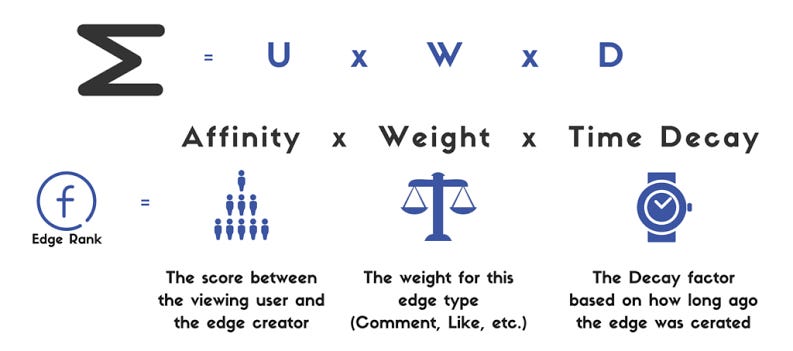
This was the beginning of us losing control.
EdgeRank would prioritise content on your news feed based on what you interacted with the most. The more you liked, shared, and commented on somebody’s content, the higher it ranked in your news feed. EdgeRank also bumped content depending on the medium in which it was shared. If you enjoyed watching videos, you saw more videos. If you enjoyed reading posts, you saw more posts. And finally the system ranked using decay rate. Content which became irrelevant very quickly was shown first in the hopes of it grabbing your attention before it was no longer of interest. Content with a slower decay rate could be saved for later. You were now seeing a curated news feed tailored specifically to you. And the more time you spent on the platform, the more sophisticated the algorithm grew.
But even this is a far cry from what we’ve built today. Social media has advanced to the point where your news feed is unrecognizable from that of your friends. And the worst part is, we are fully complicit and aware of what is happening. When the algorithm advanced we didn’t throw our phones out the window in outrage. We logged in. Because we were being given more and more of what we wanted. The hand kept feeding us and the food kept getting better. Which highlights exactly why social media is so scary. Nobody is forcing us to use it. We welcomed it into our homes with open arms.
When we look back, this path was inevitable. Social media platforms have never charged users because they operated under the veil that they were on a mission to help connect the world. And why that may have been true in the onset, connecting the world is not a cheap endeavour. Sooner or later the purse holders in charge came to realise that in order to grow the platforms they needed to make money. This left them with two options: charge users or charge companies to reach users. The former would have caused millions of people to disconnect. So the latter won out.
The platforms stayed free and we became the product.
The algorithm was not built out of a desire to give us a better experience or increase connections. The algorithm doesn’t show us more of what we want. The algorithm shows us more of what will keep us on the platform because you are only valuable to them when you’re scrolling and engaging: the longer you stay on the platform the more adverts they can show you and the more money they can make. Multiply this by billions of users and you’ve got a pretty lucrative business.
Today, there’s around six billion people who have social media accounts, which is close to 70% of the world’s population. The vast majority of those not on social media fall into markets which are not accessible. They are impoverished, infants and children, the elderly, and the disabled. Meta (Facebook) captured so much of the world’s population they went as far as providing internet access to impoverished parts of the world. They provided access to a restricted list of websites, which of course included Facebook, and framed it as a philanthropic pursuit providing a ‘digital education’ to those in-need. It’s not my place to determine whether that’s a good thing or not, but it does illustrate just how big these companies are. They captured so much of the world’s population they had to provide internet access to people so they could become users.
Once these companies had reached everybody on the planet, they were left with only one choice: increase the amount of time each user spends on the platform. The result of making the consumer the product is that these companies then bend their ethics to the currency that pays, and that currency is attention.
The only way to increase the time spent on the platform is to increase its addictiveness. And in order to increase the addictiveness of social media, the tech companies turned to the experts in addiction design, the creators of the slot machine.
Gambling was the first officially recognised form of behavioural (non-substance) addiction and the billions of dollars they spent researching addiction design is what fed the early iterations of social media algorithms.
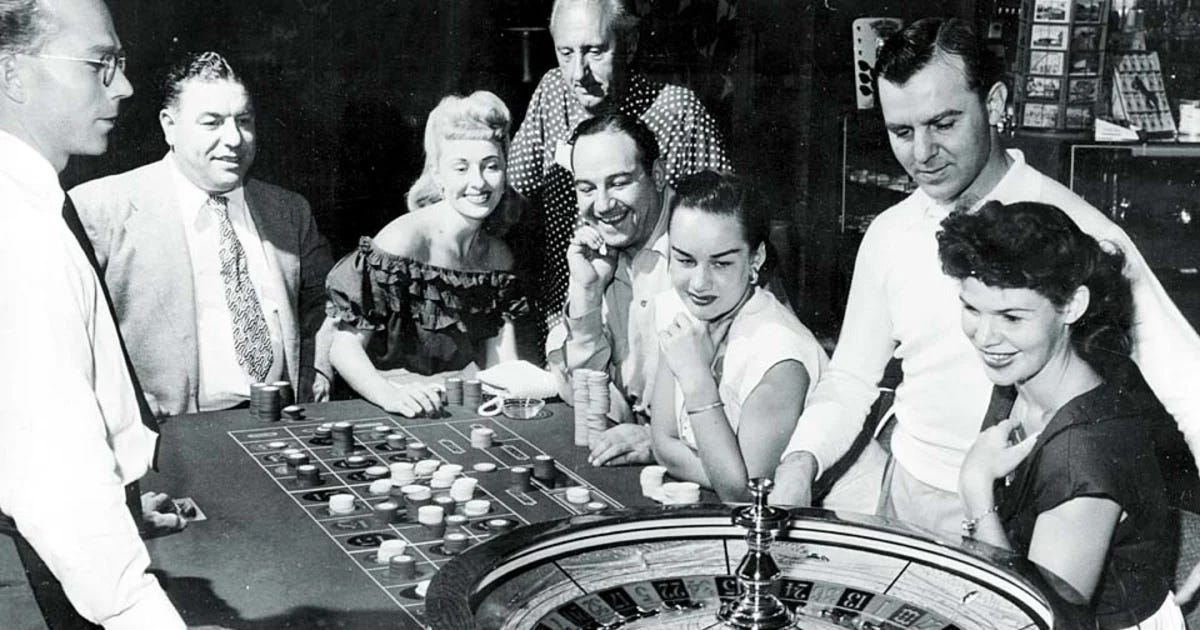
Casinos are a petri dish for studying human behaviour. The environment can be controlled and manipulated on every level: the smells, the music, the ambience, the lights, the temperature, the feedback loops, everything. And you have a constant stream of diverse and willing participants walking in and out of your lab every hour of the day.
Michael Easter breaks down the mechanisms behind slot machines using a three phase system (I highly recommend reading his work if you’re not familiar).
The first thing these systems offer is an opportunity to gain something valuable. In slot machines, this is money. In social media, this is entertainment or a supposedly valuable piece of information that might just make you richer, happier, skinnier or whatever else you’re seeking. The second mechanism is the variable reward system. You know you will eventually get something of value, but you don’t know how valuable it will be or when it will appear. You simply have to stick with it and all will be revealed. The third and final mechanism is the immediate repeatability of the behaviour. Both slot machines and scrolling are repeatable, meaning you can simply keep going until you run out of money or you fall asleep. This is unique to slot machines and algorithms as most addictive behaviours are not repeated immediately. Most smokers don’t chain smoke and most alcoholics are not perpetually drunk. The action is habitual in that you partake in it frequently, but very few are immediately repeating the addictive behaviour.
The sinister nature of social media doesn’t stop with simply keeping you on the platform. The most recent development we’ve seen is the manipulation of opinion. Instead of showing you what might keep you on the platform, social media began showing us content that would direct our opinions. The Cambridge Analytica scandal is a great example of how billions of data points was used to impact your political stance. The platforms began showing different demographics different political messages with the goal of dividing and conquering.
The goal of social media is no longer to educate or entertain you, it’s to engage you. The influencers you follow are financially incentivised by engagement, whether that’s getting you to watch more of their content or purchase their products. That’s not to say they are all bad. I think many of them are well intentioned. But don’t get it confused, their content may be educational and entertaining, but their north star is engagement. I can also tell you from first hand experience that many of these people you follow so blindly are not consuming content on the platforms they use to harvest your attention. They’re using it as a tool for distribution. Again, there’s nothing fundamentally wrong with that, but don’t kid yourself into thinking this is an altruistic behaviour.
Stay on social media, delete all your profiles, the choice is yours. I have no horse in this race. But I’d like to put forward a challenge to you. Try and go one day without vertical scrolling. Watch videos on YouTube, but search for the channel and don’t scroll through your home page. Watch Netflix, but search for the film or TV show you want to watch. Spend one day where everything you consume is intentional.
The point is not to convince you to quit social media but for you to realise just how much of the world you perceive is dictated by an algorithm.
If you grew up with social media and the internet, understand that you will spend more time observing the curated lives of others than you will living your own.
I’ll leave you with an extract from the book, Amusing Ourselves to Death:
“Orwell [author of 1984] warns that we will be overcome by an externally imposed oppression. But in Huxley’s vision, no Big Brother is required to deprive people of their autonomy, maturity and history. As he saw it, people will come to love their oppression, to adore the technologies that undo their capacities to think…Orwell feared that what we hate will ruin us. Huxley feared that what we love will ruin us.”
Go outside,
Robbie
“We shape our tools, and thereafter they shape us.”
Marshall McLuhan